Recipe guide
Negroni and Americano
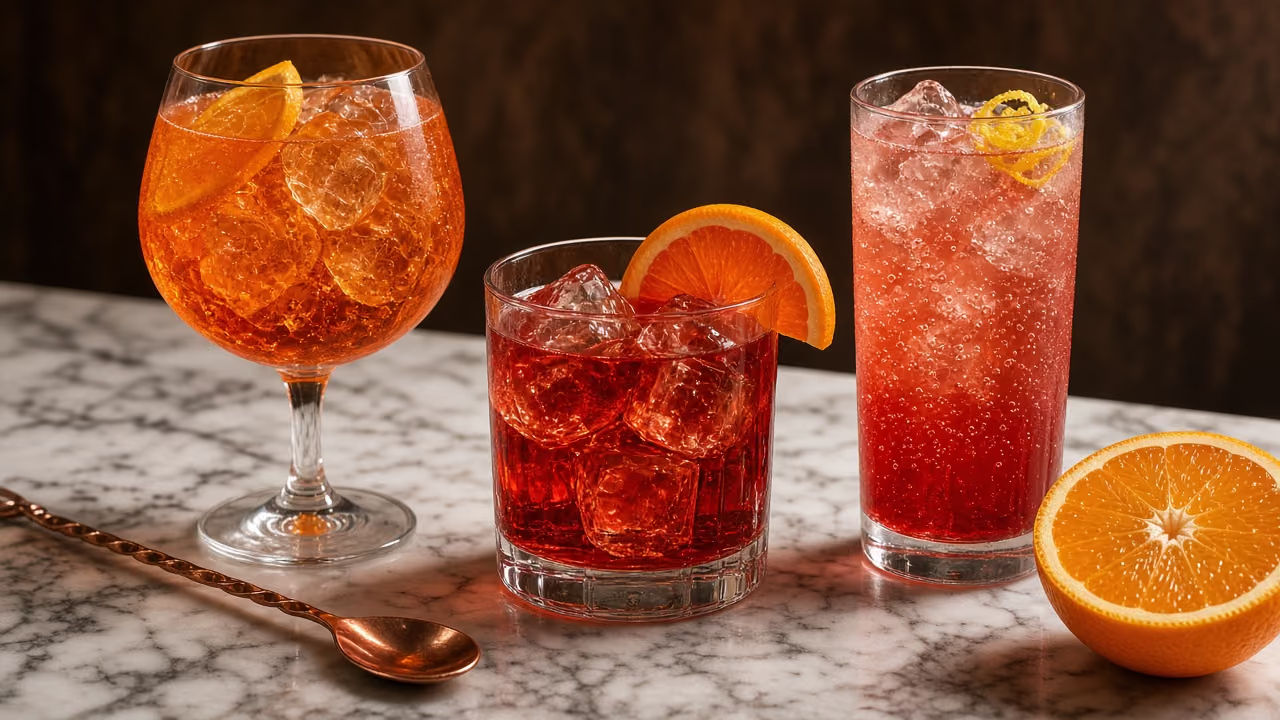
These two Campari drinks are the same family photographed at different distances. The Negroni is equal parts and stirred. The Americano is lengthened with soda. The IBA publishes both.
At a glance
- 30 ml / 30 ml / 30 ml
- Negroni
- 30 ml / 30 ml / soda
- Americano
- Stir or build, never shake
- Method
- Campari
- Shared bitter
If you only learn two stirred-looking drinks for aperitivo, learn these. They share a bitter and a vermouth. They disagree about gin and soda. That disagreement is the whole craft lesson.
The International Bartenders Association publishes both on its official list: the Negroni and the Americano. This guide keeps their measures intact and then talks about ice, vermouth freshness and when to choose the longer glass.
The official Negroni
- 30 ml gin
- 30 ml Campari
- 30 ml sweet red vermouth
- Pour into a chilled old-fashioned glass filled with ice
- Stir gently
- Garnish with half an orange slice
Equal parts is not a suggestion. It is the architecture. If you “improve” it with more gin, you have a gin cocktail with Campari in it. If you drown it in vermouth, you have a wine cocktail with a bitter accent. Both can be delicious. Neither is the IBA drink.
The IBA specifies Bitter Campari, not a generic red bitter, and sweet red vermouth, not dry. Gin is not styled beyond “gin”; the perfume you choose (juniper-heavy, citrus-heavy, Australian native-heavy) is the main variable that still leaves you inside the specification.
Stir. Do not shake. You want a clear, cold drink with a thin sheen, not a cloudy foam.
The official Americano
- 30 ml Campari
- 30 ml sweet red vermouth
- A splash of soda water
- Build in an old-fashioned glass over ice
- Stir gently
- Garnish with half an orange slice and a lemon zest
Remove the gin, add soda, and the drink becomes a wine-and-bitter highball in a short glass. The extra garnish is a clue: lemon zest sits on the Americano because the drink is lighter and needs a brighter top.
The IBA’s own history notes on the wider cocktail list treat the Americano as the older Campari-and-vermouth serve; folklore then attaches a later gin request that becomes the Negroni. We will not turn café legend into a dated fact. We will say: the two recipes are published, they share two ingredients, and the gin is the fork in the road.
Which glass for which hour
Choose the Americano when the afternoon is hot, when you want a longer first drink, or when gin would shout over the snacks. Choose the Negroni when you want density, when the wind has cooled the balcony, or when the snack plate is fatty enough to argue with Campari.
Neither drink is dinner. A Negroni in particular is easy to treat as a main event because it is composed and photogenic. It is still a prelude. If you pour a second, do it as a decision, not as autopilot.
Vermouth is the quiet failure
Both drinks die when the vermouth is tired. Sweet red vermouth is wine. Opened, it wants the fridge. Regal Rogue tells drinkers to refrigerate and finish within 60 days. If your bottle has lived on a warm shelf since last winter, do not blame Campari for the cardboard finish.
Taste the vermouth alone, cold, on a spoon. If it smells like old raisins and nail varnish, cook with it or throw it away. Then buy a format you will finish. Australian sweet or bold red styles from Maidenii or Regal Rogue are legitimate in the vermouth slot; the IBA bitter slot remains Campari if you want the official name.
Ice, chill, garnish
Chill the Negroni glass. The IBA says so. Fill it with ice, then pour, then stir. A single large cube looks handsome and melts slower; a glass of proper cubes chills faster. Either is honest. A handful of wet half-moons from a broken tray is how the drink becomes pink water.
Orange is not optional decoration. On the Negroni it oils the top of a dense drink. On the Americano, orange plus lemon zest is the specified finish. Express the peel if you like — that is method, not a secret recipe.
Cousins, named honestly
Sbagliato. A Negroni whose gin is replaced with sparkling wine. Not on the IBA pages cited above as its own official listing in the same way. If you make it, call it a sbagliato.
Boulevardier. Whiskey, Campari, sweet vermouth. An IBA official cocktail in its own right, and more of an evening drink than a first prelude. We mention it so you do not call it a Negroni.
Aperol versions. An Aperol equal-parts drink with gin and vermouth is a house cocktail. It is lighter and more orange. It is not a Negroni.
Marionette bitter curaçao. The producer prints Negroni- and Americano-shaped recipes using its bitter curaçao. Follow their measures if you are making their drink. Do not relabel it as IBA.
A home sequence that keeps dinner intact
- Put water on the table.
- Taste the vermouth.
- Ice the glasses.
- Pour Americanos first if the group is mixed in appetite; Negronis if everyone asked for the dense drink.
- Salt on the plate before the second sip — see food pairings.
- When the pan goes on for dinner, the cocktail glasses leave the table.
The hosting version of this sequence is in hosting aperitivo at home.
What we will not attach to these drinks
We will not invent the year a count walked into a café. We will not invent ABV charts. We will not price a pour. We will not rank Melbourne “Negroni bars”. We will not tell you how many you can have. We will tell you the IBA measures, the difference soda makes, and the Australian health pages: NHMRC and DrinkWise.
If you came from the old /drinks-menu/ or /wine-list/ paths, those addresses no longer sell a venue list. They point at culture. These two glasses are the culture: Campari, vermouth, and a decision about gin.
A short troubleshooting list
- Too bitter. Your ice melted too late, or you skipped the orange, or you served it without salt.
- Too sweet. The vermouth is a dessert style, or it is old and concentrated in the wrong way. Try a drier sweet vermouth, still red.
- Too hot with alcohol. You poured a Negroni when you wanted an Americano. Add soda to the next one; do not try to unscrew gin from a finished glass.
- Cloudy. You shook it. Stir the next one.
- Flat Americano. The soda was warm or you added it first. Soda last, from a fresh bottle.
Learn these two and the rest of aperitivo becomes variation: more wine, more soda, a local vermouth, a different bitter named out loud. The official pages remain the spine.
Gin, in the Negroni only
The IBA says “gin”. It does not specify a brand or a native-botanical story. A London dry will read as juniper and citrus peel against Campari. An Australian gin with myrtle or finger lime will perfume the drink differently. Either is still a Negroni if the other two measures stay Campari and sweet red vermouth. If you change those, change the name.
Do not “gin-forward” the official drink by pouring 45 ml and calling it traditional. If you want a stronger gin note, that is a house pour. Say so. The equal-parts architecture is how the bitter and the wine stay visible.
Soda, in the Americano only
The splash is a lengthener, not a highball hose. Add it last, from a cold bottle, and taste. You can always add more. You cannot take it out. Warm soda is how the drink tastes like a leftover. Flavoured soda is how the drink becomes a different recipe.
If you want a longer, colder Americano in heat, use more ice before you use more soda. Dilution from honest ice is cleaner than a glass of bubbles with a memory of Campari.
A shopping list without prices
- Campari
- Sweet red vermouth you will refrigerate
- Gin, if you want the Negroni
- Soda, if you want the Americano
- Oranges, and a lemon for the Americano zest
- Ice
- Old-fashioned glasses
That is enough. A mixing glass is useful and not required; the IBA methods are in-glass. A jigger is useful because equal parts should be equal. Your eye is not a jigger when you are talking.
For the hour around the glass, read what aperitivo is. For the wine that goes stale, read vermouth explained. For the snacks that stand up to Campari, read cicchetti and snacks. Alcohol remains 18+; the health pages remain the NHMRC and DrinkWise.
One more time, because these two drinks are easy to mash together in the memory: the Negroni is gin plus Campari plus sweet red vermouth, equal parts, stirred. The Americano is Campari plus sweet red vermouth plus soda, built. Same bitter, same wine, different job. Pour the one that leaves room for dinner. Leave the café legends on the café. The citable objects are the two IBA pages and the vermouth in your fridge.
What people ask first
What is a Negroni?
What is an Americano cocktail?
Which one is the aperitivo drink?
The Americano is the gentler prelude; the Negroni is the denser one. Choose with the meal still in mind.
Can I swap Campari for Aperol?
Name the swap.
Pitch a drinks or food guide
Guest posts that teach a recipe, a pairing or a producer — with primary sources — are welcome. We do not publish venue round-ups or invented rankings.