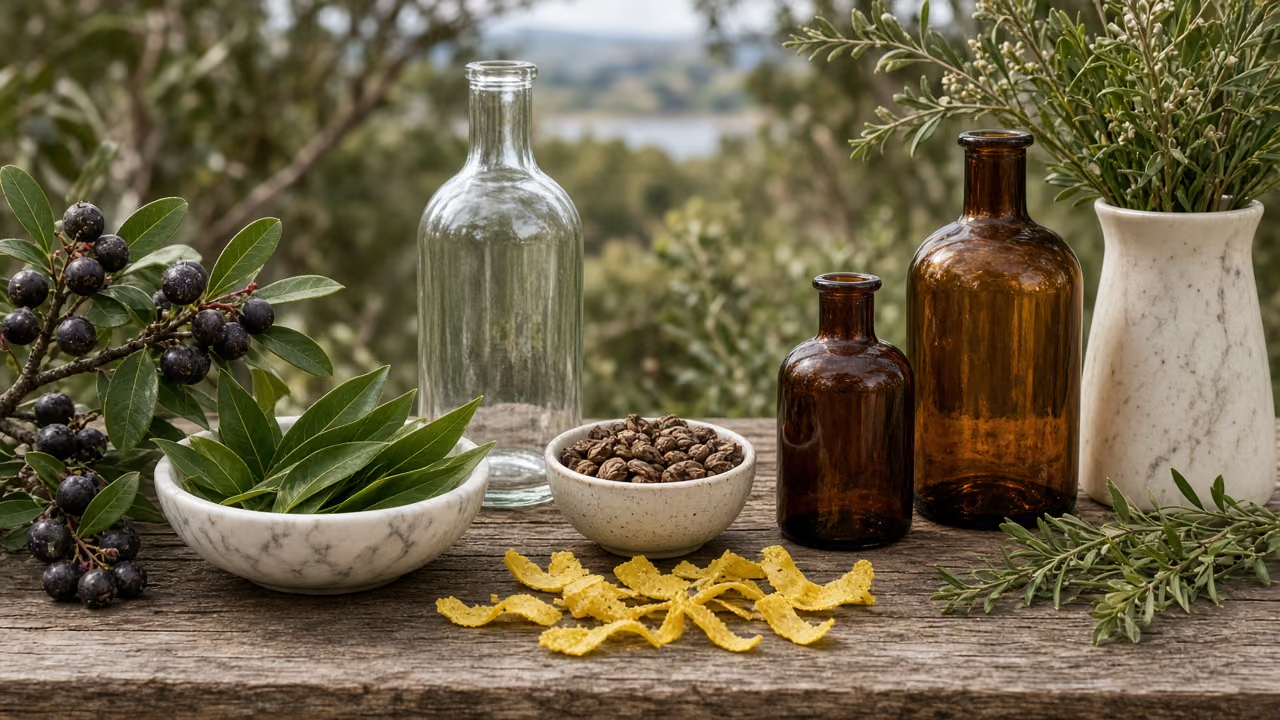
Local bottles
Australian aperitif makers
Australia makes vermouth and bitter aperitifs that belong on an aperitivo tray. This guide repeats what the makers publish, and stops where the primary page stops.
At a glance
- Four primary sources
- Named
- Vermouth and bitter liqueur
- Category
- Link or leave out
- Rule
- Not listed
- Venues
Italian bottles taught the world the grammar of aperitivo. Australian bottles are allowed to speak it with local wine and native botanicals. The danger, on a culture site, is to turn that sentence into a prize night. This guide will not. It is a reading of four primary pages, plus a method for putting those bottles on a tray without mislabelling official cocktails.
If you want the short hub, use Australian producers. If you want the pantry science, use vermouth explained.
The citation rule
A producer appears here when:
- Their own site says they make a vermouth, aperitif or bitter liqueur relevant to this ritual.
- We can link that claim.
- We do not need a journalist’s ranking to complete the sentence.
A producer does not appear here because we “heard they were good”, because an old article named them, or because a bar list we are not allowed to publish once poured them. When a page dies, the name should come off until a new primary source exists.
We do not list operating venues. A bottle is not a room.
Maidenii
Maidenii publishes vermouths, including a Dry the maker describes as designed with the classic Martini in mind, and a Roselle the maker describes as more aperitivo-leaning, with bitterness from roots including gentian and a wine base from Heathcote grapes fermented as rosé. The site discusses Australian natives such as strawberry gum, Tasmanian pepperberry and saltbush. It also points to The Book of Vermouth by Gilles Lapalus and Shaun Byrne.
What we take from that: this is a vermouth producer who wants you to drink the wine on its own terms, not only as a mixer. A Maidenii dry on ice with orange or lemon is already aperitivo. A Maidenii sweet or roselle-style bottle can sit in a Negroni-shaped serve if you name the vermouth.
What we do not take: scores, “best in Australia”, or a botanical ranking. Those would be our invention.
Regal Rogue
Regal Rogue presents itself as an organic Australian aperitif maker and dates that work to 2011. The varietals page describes organic Australian wine and indigenous botanicals, and discusses styles including Daring Dry (sauvignon blanc; anise myrtle, quandong, native thyme among the published notes) and Bold Red (shiraz and un-wooded chardonnay; pepperberry, wattleseed, native thyme among the published notes). The same page tells you that opened vermouth should be refrigerated and consumed within 60 days, or used in cooking.
That storage line is the most useful sentence on this whole list. It is also why Regal Rogue appears whenever this site talks about fridge space. We repeat it because it is a producer instruction, not because we ran a lab.
If you use Daring Dry on ice, you are drinking their extra-dry vermouth. If you use Bold Red in an Americano-shaped drink, you are using an Australian red vermouth in a Campari drink — still an Americano method, local wine.
78 Degrees Distillery
The dry vermouth product page at 78 Degrees describes a Torino-inspired botanical idea over McLaren Vale Chenin Blanc, with karkalla, wattleseed, native thyme, sunrise lime, lemon myrtle, anise myrtle and finger lime. It discusses Adelaide Hills Distillery as the originating name and the Adelaide Hills as the landscape.
What we take: a dry vermouth with published salinity and citrus natives, useful on ice and in a martini-shaped serve. What we do not take: medals, scores, or a comparison against Maidenii. Different wines, different pages.
Marionette
Marionette is the odd one in this list on purpose. The producer makes liqueurs, not vermouth. The relevant bottle for aperitivo is the bitter curaçao: an orange-led bitter the maker itself puts into Negroni- and Americano-shaped recipes (30 ml bitter curaçao with gin and vermouth; 30 ml with vermouth and soda). The site also publishes orange curaçao and blue curaçao, which belong more to other cocktail families.
If you pour a Marionette bitter Negroni, say that. The IBA Negroni specifies Campari. Honesty is the whole difference between a house drink and a mislabelled official one.
How to use these bottles without lying
- On ice. The cleanest way to learn any of the vermouths. Citrus, maybe soda, maybe an olive.
- In an IBA drink. You may swap the vermouth and still describe the method as Negroni or Americano. If you swap the bitter, change the name.
- In a Spritz. The IBA Spritz is Prosecco, Aperol, soda. An Australian bitter spritz is a spritz. It is not an Aperol Spritz.
- On a mixed tray. One local bottle plus one official recipe is plenty. A tasting flight of six is a different event and usually warms the wine.
What “native botanicals” does and does not mean
Pepperberry, myrtle, wattleseed, saltbush and karkalla appear on these producer pages. They are flavour. They are not a moral ranking and they are not a guarantee that a drink will “taste Australian” in a way your guests can guess in a blind sip. Taste, then describe. Do not write a poem about the outback unless the maker did, and then quote the maker’s page — which, on these four sites, is more precise than that.
The list will stay short until the sources grow
There are other Australian makers. Some will belong here when a product page is checked. Some make gin with an aperitif line that is really a gin. Some make wine that is not aromatised. This site would rather be incomplete than decorative.
If you produce a vermouth or bitter aperitif in Australia and want it considered, send the product URL via contact. Send the page that states the category, the wine or spirit base, and the botanicals. Do not send a PDF of awards. We will not invent a medal table.
Service, age, leftover wine
Treat opened local vermouth like any vermouth: fridge, date on the label, finish on a kitchen timescale. Regal Rogue’s 60-day note is the one we can cite; others may differ.
These drinks are 18+. A local botanical bill does not change the NHMRC or DrinkWise advice.
Leftover dry vermouth belongs in a pan. Leftover bitter liqueur belongs capped, cool, and not next to the oven. Leftover marketing copy belongs on the producer’s site, not rewritten as our review.
The hour is still the same hour: a bitter or wine-led glass, a salty bite, dinner. The Australian bottle is a pleasure in that hour, not a mascot for it.
A tasting flight that is still aperitivo
If you insist on comparing two local vermouths, pour them the same way: same ice, same citrus, same water on the table, same olive. Write what you taste. Do not score them. Do not invite a crowd large enough to warm the bottles. Two glasses is a flight. Twenty is a party, and parties flatten nuance.
A bitter liqueur should not be lined up against a vermouth as if they were the same homework. One is wine. One is a liqueur. The Americano exists to put them in conversation with Campari, not to collapse the categories.
Buying, storing, finishing
Buy the format you will finish. We will not print a price or a shop. We will print the storage rule we can cite: Regal Rogue says refrigerate and consume within 60 days. Write the date on every open bottle, local or imported. Keep them out of the sun. Cook with the last glass of dry vermouth rather than pouring it into a Negroni you will then blame.
If a bottle is a gift you will not drink, give it to someone who will, or cook. A shrine of unopened aperitifs is not a culture guide. It is a cupboard.
Where these pages sit in the IA
The hub is Australian producers. The pantry is bitters and vermouth. The official mixed drinks remain European in specification: Spritz, Negroni, Americano. Local bottles enter those drinks as named substitutions, or they stand alone on ice. That is enough of a national story without a medal table.
Corrections and new primary URLs go to contact. 18+. NHMRC. DrinkWise.
A last practical note: if you can only buy one local bottle this month, choose a vermouth you will drink on ice. That is the fastest way to learn the category without mislabelling a Negroni. Save the bitter liqueur for a night when you want to say the house name out loud. Save the imported Campari and Aperol for the nights you want the official pages to apply without a footnote. None of those choices is a ranking. They are three different sentences, and this site is in the business of keeping sentences accurate.
What people ask first
Are there Australian vermouth producers?
Maidenii, Regal Rogue and 78 Degrees Distillery all publish vermouths on their own websites.
When did Regal Rogue start?
Is Marionette a vermouth producer?
Marionette publishes curaçao liqueurs, including a bitter curaçao it uses in Negroni- and Americano-shaped recipes.
Why is this list short?
If a maker has no checkable product page, they are not named here.
Pitch a drinks or food guide
Guest posts that teach a recipe, a pairing or a producer — with primary sources — are welcome. We do not publish venue round-ups or invented rankings.